Closing out the flight crew block with the costs that sit on top of the wage line
The last post settled the visible cost. The 181 pilots Atlántico Airways needs to fly its fleet, the four-layer build that turns a salary into a loaded employer figure, the total wage bill of approximately €24.6 million a year. That number is the headline. It is not the whole bill.
This post deals with everything that sits on top. The training that puts a new pilot on an aircraft for the first time, the recurrent simulator checks every pilot must pass twice a year to remain legal, the command upgrades that promote first officers to captains, the cross-fleet transitions that move a pilot from the A321 to the A330. None of these costs sit on the wage line. All of them are real money, paid by the airline, and almost all of them invisible from outside the operation.
By the end of this post, Atlántico’s flight crew block will be complete. Wages plus training. The full picture of what 181 pilots really cost.
Why training is its own cost line
There is a temptation, particularly for anyone modelling an airline from outside, to treat training as part of the wage bill. It is not. The salary covers the pilot’s time and labour. The training is a separate set of costs that the airline pays to keep the pilot legally permitted to operate the aircraft, and it has to be paid whether or not the pilot flies a single revenue sector in a given year.
Strip away the recurrent training and the type ratings, and a pilot ceases to be an airline pilot overnight. Their licence becomes worthless commercially. Their employment becomes impossible. The training budget is therefore not optional, not discretionary, and not negotiable. It is the price of the operational status that the wage bill is paying for.
It is also one of the most consistently misunderstood costs in airline economics, because most of it happens out of sight. The captain you watch board the aircraft has spent at least four days in a simulator in the last six months. The first officer beside her has done the same. Neither of those days appears on any passenger’s awareness of what it takes to keep them flying.
The five training cost streams
There are five training cost streams that an airline must budget for, and each one has its own logic, its own cadence, and its own pricing structure.
The first is the initial type rating, the substantial training event that qualifies a pilot to operate a specific aircraft type for the first time. The second is recurrent training and checking, the rolling annual cost of keeping every pilot legal to fly. The third is the command upgrade, the major training programme that promotes a first officer to captain. The fourth is the cross-fleet transition, the cost of moving a pilot from one aircraft type to another, which for Atlántico means primarily from the A321 to the A330. The fifth is the instructor and examiner cost, the training of the senior captains and first officers who themselves train and check other pilots.
Each stream is sized separately below, with 2026 European market rates verified against current training provider pricing.
Stream one: initial type rating
The type rating is the single largest discrete training cost an airline incurs for a pilot. It is the course that turns a generic commercial pilot, however experienced, into a pilot legally qualified to operate a specific aircraft type. Under European rules, every aircraft over 5,700 kilograms requires a type rating, and the A321 and A330 each have their own rating.
A standalone A320 family type rating in Europe in 2026 ranges from approximately €15,000 at Spanish or Eastern European providers using Zero Flight Time Training methods, up to €35,000 at premium Western European training centres with full base training included on a real aircraft. For an airline funding the course rather than a self-paying cadet, the typical cost falls in the €20,000 to €25,000 range, since airlines negotiate volume rates with training providers and often combine the type rating with their own line training programme.
The A330 type rating is substantially more expensive, both because the simulator hourly rates are higher and because the course itself is longer. The European Aviation Safety Agency-approved initial A330 type rating runs to approximately 36 days of training, including ground school, fixed-base simulator work, full-flight simulator sessions and base training. A full initial A330 type rating from scratch costs roughly €35,000 to €50,000 in 2026.
There is, however, a significant commonality benefit between the A320 family and the A330. Airbus operates a cross-crew qualification framework that allows a pilot already type-rated on one to convert to the other through a shorter Cross-Crew Qualification course, the CCQ. For a pilot moving from the A320 family to the A330, the CCQ in 2026 costs in the region of €15,000 to €20,000, a meaningful saving against a full initial rating. This commonality benefit is one of the strategic reasons many airlines, including Atlántico, choose Airbus across both their narrowbody and widebody fleets.
Beyond the type rating itself, two further layers sit on top. The Multi-Crew Cooperation course, the MCC, that we covered in our earlier posts, is required for any pilot operating a multi-pilot aircraft for the first time. It costs around €3,000 to €5,000, and is often bundled into the type rating course for new joiners. Line training, the supervised flying that follows the simulator phase before a pilot is signed off for unrestricted line operations, is largely absorbed into the airline’s own roster as the training captain is already on the payroll, but it carries an opportunity cost because the trainee is not yet generating full productivity.
For Atlántico, with a stable mature fleet, annual new type rating costs come from two sources. New pilot recruitment to replace attrition and modest growth, typically around eight to twelve pilots a year, and cross-fleet transitions where a first officer or captain moves from the A321 to the A330 or vice versa, typically two to four pilots a year. The blended annual training bill from initial type ratings and cross-fleet transitions is around €400,000.
Stream two: recurrent training and checking
This is the rolling annual cost that every airline carries, every year, for every pilot on the books, and it is the largest of the training streams in total euros because it touches all 181 pilots rather than a small subset.
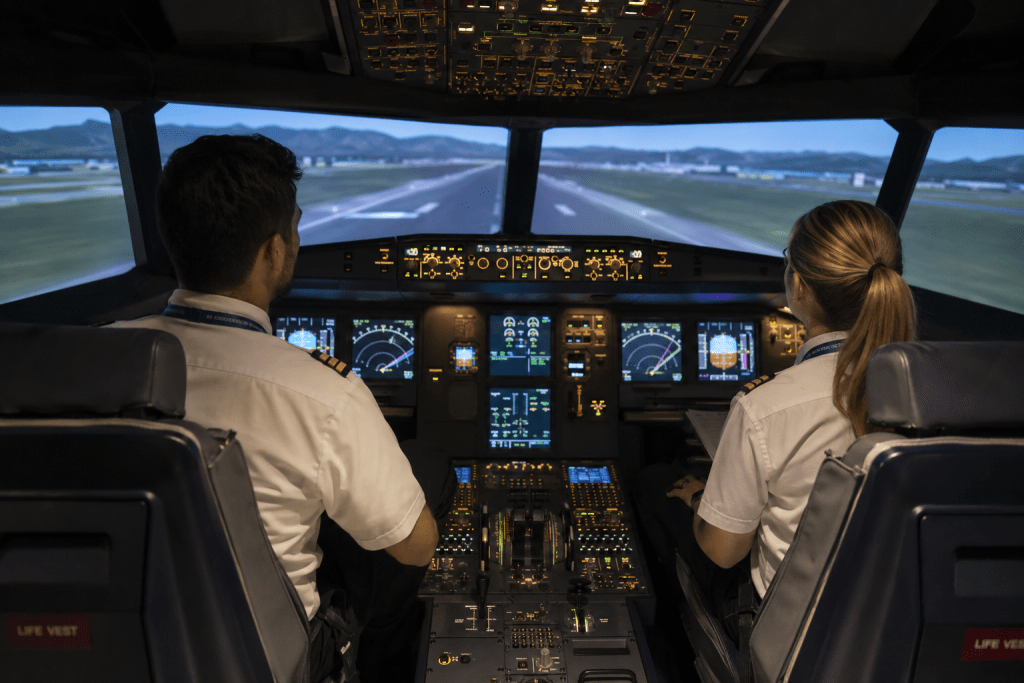
Under European rules, every commercial pilot must complete a Licence Proficiency Check at least once every twelve months, and an Operator Proficiency Check, the OPC, at least once every six months. In practice these are usually combined with simulator training sessions and run as two visits to the simulator per year, each typically four hours of simulator time plus briefing and debriefing, plus the associated ground school and computer-based training that supports them.
The cost per pilot per year breaks down approximately as follows. Two simulator sessions of four hours each, leased at the 2026 European rate of around €500 to €800 per hour, cost €4,000 to €6,400 in simulator time alone. Examiner fees for the LPC, where the check is conducted by a Type Rating Examiner, add €1,000 to €2,000. The ground school component, covering Crew Resource Management, dangerous goods, security training, fire and smoke procedures, first aid, and the mandatory annual review of operational subjects, adds €500 to €1,000. Travel and accommodation, where the simulator is not at base, adds another €1,000 to €1,500 for a typical Atlántico pilot.
The total recurrent training cost per pilot per year is approximately €8,000 to €12,000 in the European market, with the variation driven by simulator location, whether the airline owns or leases sim time, and how efficiently it can pack recurrent training around the line schedule. Atlántico models €10,000 per pilot per year as a credible mid-range figure, leasing simulator time rather than owning, but with simulator centres close enough to Madrid to avoid major travel costs.
Across 181 pilots, recurrent training therefore costs approximately €1.81 million a year. This is the largest single line on the training budget.
Stream three: command upgrades
The command upgrade is the training programme that promotes a first officer to captain. It is substantially more than a recurrent check, and substantially less than a full type rating, because the pilot already knows the aircraft. What they need is to develop the additional command authority, leadership and decision-making skills required to operate as Pilot in Command, and to demonstrate those skills to an examiner.
A typical command upgrade course involves several days of command-focused ground school, between four and eight simulator sessions covering command scenarios and abnormal situations the captain must handle, a final command line check on real revenue flights under the supervision of a training captain, and the formal command licence skill test with a senior examiner. The total cost ranges from approximately €15,000 to €25,000 per upgrade in the European market, depending on the aircraft type and the airline’s specific upgrade programme. Widebody command upgrades sit at the higher end.
For Atlántico, the command upgrade rate is driven by retirement and attrition at the captain level. With 50 A321 captains on an average remaining career of around 15 years, the steady-state upgrade rate on the narrowbody fleet is approximately three a year. With 32 A330 captains on a similar profile, the widebody upgrade rate is around two a year. The blended annual upgrade cost, at roughly €20,000 average per upgrade, is approximately €100,000 a year.
This is a smaller absolute figure than recurrent training, but it has disproportionate strategic importance. A well-managed command upgrade pipeline is what allows an airline to promote captains internally rather than recruiting expensive external captains in a tight market, which we noted in the last post is one of the most cost-effective decisions a flight operations management team can make. A weak pipeline, by contrast, forces the airline to buy in captains at market rates while losing junior first officers to competitors who can offer faster progression.
Stream four: cross-fleet transitions
A cross-fleet transition moves a pilot from one aircraft type to another within the airline. For Atlántico this is almost always a movement from the A321 to the A330, typically as part of a career progression where an experienced narrowbody pilot wants the long-haul widebody flying, or a strategic redeployment where the airline needs more widebody crews. Occasionally a transition runs the other way, where a widebody pilot moves back to the narrowbody for lifestyle reasons.
The cost of a cross-fleet transition is principally the CCQ course discussed in Stream One, at approximately €15,000 to €20,000 in 2026. Atlántico runs approximately two to four cross-fleet transitions a year, costing in the region of €40,000 to €80,000 annually. This figure is already counted within the broader initial type rating bill in Stream One, so it is not added separately here.
Stream five: instructor and examiner costs
The training and checking system requires its own instructors and examiners. Type Rating Instructors, the TRIs, conduct the simulator training for type ratings and recurrent sessions. Type Rating Examiners, the TREs, conduct the formal Licence Proficiency Checks. Line Training Captains, the LTCs, supervise line training and route checks. Synthetic Flight Instructors and Synthetic Flight Examiners handle simulator-only roles in some airlines.
These pilots are drawn from the existing captain population, but they require additional qualification courses themselves. A TRI qualification course runs approximately €5,000 to €10,000 per instructor, plus refresher requirements every three years. A TRE adds another €3,000 to €5,000 on top of TRI qualification. An LTC qualification is shorter and lighter.
Atlántico’s instructor and examiner population is small, typically around twelve to fifteen pilots across both fleets serving as TRIs, TREs and LTCs. The annual qualification and refresher cost for this group runs in the region of €40,000 to €60,000.
The total training bill for Atlántico
Adding the five streams together for the Atlántico fleet:
Initial type ratings, including new joiner and cross-fleet costs, are approximately €400,000 a year. Recurrent training and checking, across all 181 pilots at €10,000 each, is approximately €1.81 million. Command upgrades, at around five a year, are approximately €100,000. Instructor and examiner qualification and refresher is approximately €50,000.
The total annual flight crew training bill for Atlántico Airways is approximately €2.4 million.
Combined with the loaded wage bill of €24.6 million from the last post, the complete flight crew block for Atlántico stands at approximately €27 million a year, or roughly 5.6% of the airline’s €480 million total operating cost.
Why this matters
The training bill is the cost most readily forgotten when modelling an airline from outside. It is invisible to passengers, rarely cited in journalism, and almost never raised in public arguments about pilot pay. It is also one of the lines where strategic decisions made years earlier produce significant cost consequences in the present.
Choosing Airbus across both fleets, as Atlántico has done, captures the A320 to A330 commonality benefit and reduces cross-fleet transition costs. Leasing simulator time rather than owning a full-flight simulator avoids a €10 million to €15 million capital outlay that only makes sense above a much larger fleet size. Building a healthy command upgrade pipeline internally reduces dependence on expensive external captain recruitment. Investing in a deep TRI and TRE bench gives the airline control over its own training quality and reduces the cost of external examiner fees.
None of these decisions show up on the wage line. All of them show up on the training line, year after year, for the life of the airline.
What comes next
The flight crew block is now complete. All the posts so far have built the full picture from the regulation that forces the number of pilots, through the establishment that delivers the flying programme, through the wage bill that pays them, to the training budget that keeps them legal to fly. The complete cost: approximately €27 million a year for 181 pilots.
Topic 2 begins next. Cabin crew, the largest single workforce on the payroll, sized by entirely different rules, paid on entirely different scales, and carrying a cost structure that catches almost everyone by surprise. The 543 cabin crew Atlántico operates with, costed from the ground up the same way the pilots have been, with the same forensic discipline applied to every number.
About OAT
This series is produced by OAT. We build technically rigorous aviation training, designed by people who have worked the operation rather than just written about it.
If your organisation has training needs, we can help. Our courses are SCORM compliant and ready to drop straight into your existing Learning Management System. We also offer flexible hosting options if you would rather we ran the platform for you, alongside full outsource options for organisations that want their training designed, built and managed end to end.
Get in touch at info@oat.aero or visit oat.aero to talk through what you need