
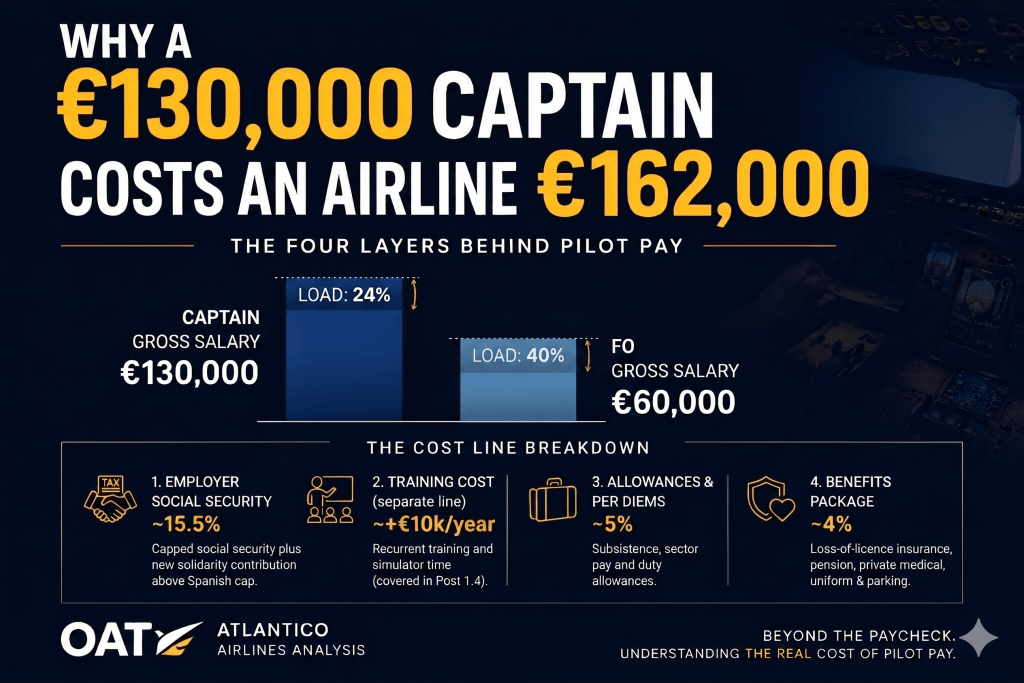
Turning a salary into a loaded employer cost
This is the post where the cost base for flight crew finally lands. prior posts set out the regulation, sized the establishment at 181 pilots. Now we cost them, with the same forensic discipline applied to every number, and with the 2026 Spanish framework verified to the cent.
There is a reason this post is longer than the previous two. A pilot’s salary is never what the pilot costs. The headline figure quoted in newspaper articles and pilot forums is the base salary, the gross pay before any of the other layers are added. The real cost to the airline, the figure that hits the wage line on the profit and loss account, is built from four separate components stacked on top of that base. Each one behaves differently. One of them, the Spanish social security cap, behaves in a way most people get wrong, and getting it right matters because it changes the cost of a senior captain by tens of thousands of euros a year.
By the end of this post, Atlántico’s 181-pilot establishment will be costed in full. Every layer named. Every number traceable. The total will be defensible against any aviation finance professional who wants to challenge it.
What a pilot’s cost is actually made of
A pilot’s loaded cost to the airline is the sum of four layers. The base salary, the employer social security contribution, the allowances and per diems, and the benefits package. Each layer is real money and each one is paid by the airline whether the pilot flies a single hour above their roster or not.
The base salary is the gross figure named in the contract. It is what a pilot tells you they earn when asked at a dinner party, and it is the figure published in salary surveys. For an Atlántico A321 captain in 2026 it sits at around €130,000. For a senior A330 captain it sits at around €160,000.
The employer social security contribution is what the airline pays to the Spanish state on top of the salary, funding the public healthcare system, the state pension, unemployment insurance, the wage guarantee fund, and a small fund for occupational accidents. It is mandatory and non-negotiable. Crucially, it is capped, and the cap is the bit most people get wrong.
The allowances and per diems are the cash payments that compensate pilots for time away from base. They cover meals, incidentals, sector pay where applicable, and other duty-related expenses. They are modest for short-haul operations, where pilots are home most nights, and material for long-haul operations, where layovers in distant cities are routine.
The benefits package is the smaller but still significant set of indirect costs. The loss-of-licence insurance that protects a pilot’s livelihood if they fail a Class 1 medical, the private medical cover that supplements the public system, the pension contributions on top of state provision, and the smaller items like uniform allowance and parking.
The total loaded cost of a pilot is base plus social security plus allowances plus benefits. It is always meaningfully more than the salary number alone, and the gap between salary and loaded cost varies depending on where the salary sits relative to the social security cap.
Layer one: the base salaries
Atlántico operates in the Spanish market, where pilot pay is shaped by the collective bargaining agreements known as convenios colectivos. The market splits into clear tiers. At the top, Iberia long-haul captains reach €170,000 or more. Below that sits Air Europa, with widebody captains in the €145,000 to €165,000 range. Iberia Express and the European low-cost carriers operating Spanish bases occupy the middle, with A321 captains between €110,000 and €148,000. Vueling and the regional carriers sit below that. Across the whole market, first officers run from €40,000 at entry level to €82,000 at the senior end of a low-cost carrier.
Atlántico positions itself as a hybrid carrier, paying mid-market rates that are competitive enough to recruit experienced crews but not at the legacy peak. For this cost base we model the following 2026 figures, drawn from the airmappr.com European salary survey, the readyfortakeoffbook.com Spanish carrier breakdown, and verified against the SEPLA collective agreement framework.
An A321 captain is modelled at €130,000 gross base. An A321 first officer is modelled at €60,000. On the widebody fleet, an A330 captain is modelled at €160,000, an A330 senior first officer at €100,000, and an A330 first officer at €75,000. These are gross base salaries, before any other layer is added.
Note that 2026 has seen pilot pay rise sharply across Europe, with the airmappr.com survey reporting increases of 8 to 12% year on year against a backdrop of around 38,000 unfilled pilot positions globally. The industry is in what union sources have begun describing as an arms race, and the figures above reflect that current heat.
Layer two: the Spanish social security cap
This is the layer where most cost models go wrong, because the Spanish social security system does something that English-language sources rarely explain properly. It caps the employer’s contribution at a fixed maximum, and that cap has a dramatic effect on the loaded cost of high-earning roles.
The 2026 Spanish framework is set out in the contribution order published by the Ministry of Inclusion, Social Security and Migration. The maximum monthly contribution base for 2026 is €5,101.20, which equates to an annual cap of €61,214.40. The general employer contribution rate is 30.65% on that capped base, comprising 23.60% for common contingencies (healthcare and pensions), 5.50% for unemployment, 0.20% for FOGASA (the wage guarantee fund), 0.60% for professional training, and around 0.75% for occupational accidents in a typical office or aviation environment.
On top of that, the Intergenerational Equity Mechanism, known as MEI, increases from 0.80% to 0.90% on 1 January 2026, with the employer share rising to 0.75%. This brings the total employer contribution rate on the capped base to approximately 31.4%.
The maximum annual employer social security contribution on the capped portion is therefore €61,214.40 multiplied by 31.4%, which is €19,221. This is the most any Spanish employer pays in standard social security on any single employee, regardless of how much that employee earns above the cap.
In 2025, a new solidarity contribution was introduced for remuneration above the maximum base. In 2026 it operates as a three-tier progressive surcharge on the excess portion of salary. The first tier covers the portion from the cap to 10% above it, at 1.15%. The second tier covers the portion from 10% to 50% above the cap, at 1.25%. The third tier covers everything above 50% over the cap, at 1.46%. The solidarity contribution is the only additional employer charge on salary above €61,214, and the rates are scheduled to rise gradually each year until 2045.
The practical consequence is striking. An A321 captain on €130,000 pays full social security only on the first €61,214 of salary, and then only the modest solidarity contribution on the €68,786 excess. The total employer social security cost on that captain is €19,221 in capped contributions plus around €963 in solidarity contribution, giving roughly €20,184. That works out at an effective rate of 15.5% of the gross salary, not the 30% headline rate that applies in full to lower earners.
An A321 first officer on €60,000, by contrast, sits entirely below the cap. The full 31.4% employer rate applies to the whole salary, costing the airline €18,840 in social security alone, or 31.4% of gross. The same first officer earns less than half the captain, but loads at twice the percentage rate.
This single feature of Spanish payroll has a profound effect on the relative cost of senior versus junior crew, and it is why a credible airline cost model must build social security cost from the cap upward, not as a flat percentage of salary.
Layer three: allowances and per diems
Allowances exist because pilots, particularly long-haul ones, spend significant time away from base, eating in hotels, paying for local transport, and incurring incidentals that the airline reimburses through a daily subsistence rate. The exact structure varies by airline and by collective agreement, but the components are broadly similar.
The most common element is the per diem, a daily subsistence rate paid for nights away from base. For European short-haul operations, per diems are modest, typically €40 to €70 per night. For long-haul layovers in expensive cities, they rise substantially, often €120 to €200 per night, plus separate meal allowances. Beyond the daily rate, some carriers pay sector pay, a flat fee per sector flown above a baseline number, which becomes significant for short-haul crew flying high-frequency rosters. Duty allowances, training allowances when conducting line training or instructional work, and night flying premiums add further small layers.
For Atlántico’s cost model, allowances are sized as a percentage of base salary, calibrated to the fleet’s operating pattern. Short-haul A321 crew, who are home most nights, receive allowances totalling approximately 5% of base salary across the year. Long-haul A330 crew, who routinely spend several nights a month in layover cities, receive allowances totalling approximately 12% of base. These figures are conservative within the typical Spanish market range and reflect a disciplined operator rather than a generous one.
Layer four: the benefits package
The fourth layer is the indirect cost of employing a pilot beyond their salary and allowances. The largest single item is loss-of-licence insurance, the cover that protects a pilot’s income if they lose their Class 1 medical and cannot fly again. Because a pilot’s earning potential is entirely tied to their medical certification, this insurance is a meaningful benefit, and most legacy and hybrid carriers provide it as standard at a cost of €500 to €1,500 per pilot per year depending on age and seniority.
Pension contributions on top of the state system are common but vary widely. Some Spanish carriers contribute a few percent of salary into a defined contribution plan, others rely on the state pension alone. For Atlántico’s model we assume a modest 2% of salary into a supplementary pension.
Private medical cover that supplements the Spanish public system is standard for legacy and full-service operators, typically costing the airline €1,000 to €2,000 per pilot per year. Add uniform allowance, mandatory training equipment provision, and small items like crew parking, and the total benefits layer comes to approximately 4% of base salary for a typical Atlántico pilot.
Putting the four layers together
For each crew category, the loaded cost is base plus social security plus allowances plus benefits. Worked through with the 2026 Spanish figures verified above, the per-head loaded costs are as follows.
An A321 captain on €130,000 gross attracts €20,184 in social security and solidarity contributions, €6,500 in allowances at 5% of base, and €5,200 in benefits at 4% of base. The total loaded cost is approximately €161,900 per captain, an effective loading of 24.5% over base.
An A321 first officer on €60,000 gross attracts €18,840 in social security, €3,000 in allowances, and €2,400 in benefits. The total loaded cost is approximately €84,200 per first officer, an effective loading of 40.4% over base. The first officer loads at a much higher percentage than the captain, despite earning less than half the salary, because all of their pay sits below the social security cap.
An A330 captain on €160,000 gross attracts €20,604 in social security and solidarity contributions, €19,200 in allowances at 12% of base, and €6,400 in benefits at 4% of base. The total loaded cost is approximately €206,200 per widebody captain, an effective loading of 28.9% over base.
An A330 senior first officer on €100,000 gross attracts €19,667 in social security and solidarity contributions, €12,000 in allowances, and €4,000 in benefits. The total loaded cost is approximately €135,700, an effective loading of 35.7%.
An A330 first officer on €75,000 gross attracts €19,380 in social security and solidarity contributions, €9,000 in allowances, and €3,000 in benefits. The total loaded cost is approximately €106,400, an effective loading of 41.8%.
The total flight crew salary bill for Atlántico
Multiplying loaded cost by establishment for each category produces the total annual flight crew wage bill.
The fifty A321 captains at €161,900 each cost approximately €8.10 million. The fifty A321 first officers at €84,200 each cost approximately €4.21 million. The thirty-two A330 captains at €206,200 each cost approximately €6.60 million. The seventeen A330 senior first officers at €135,700 each cost approximately €2.31 million. The thirty-two A330 first officers at €106,400 each cost approximately €3.40 million.
The total annual flight crew salary bill for Atlántico Airways is approximately €24.6 million.
This is the salary line for the 181 pilots. It does not yet include recurrent training, type ratings, command upgrades, or simulator time, which we cost separately in the next post because they sit on the training budget rather than the wage line. With those costs added in 1.4, the total flight crew cost block lands at around €27 million, or roughly 5.6% of Atlántico’s total operating cost.
Why this is small as a percentage and large in absolute terms
The total flight crew salary bill of €24.6 million is the most visible cost line in commercial aviation, and it is the one journalists, commentators, and the public most consistently fixate on. It is also the one that is most consistently misunderstood, because in absolute terms it is enormous, and in percentage terms it is small.
For Atlántico, this single line represents around 5.1% of the airline’s total annual operating cost of approximately €480 million. Fuel alone is roughly five times this number. Aircraft leases are roughly three times. Airport and navigation charges combined are roughly three and a half times. Pilots are visible because every passenger sees the captain’s voice on the PA, but in cost terms they are a relatively modest line on the bill.
This is the perception-reality gap that the whole series is designed to close. The pilots are not the problem. They are not the saving. They are a defensible, regulated, professionally paid layer of the operation, and the real cost levers sit elsewhere entirely.
What comes next
The next post closes out the flight crew block. It covers the costs that sit on top of the wage bill: the type rating training that puts a new pilot on the A321 or the A330, the recurrent simulator training and Licence Proficiency Checks that every pilot completes annually, the command upgrade pipeline that promotes first officers to captain, and the simulator leasing costs that come with not owning your own training devices. Together, with the next post then we give the complete picture of what a flight crew really costs an airline to operate, from the regulation up.
After that, Topic 2 begins. Cabin crew, the largest single workforce on the payroll, sized by an entirely different rule, costing the airline in ways the public never sees.
About OAT
This series is produced by OAT. We build technically rigorous aviation training, designed by people who have worked the operation rather than just written about it.
If your organisation has training needs, we can help. Our courses are SCORM compliant and ready to drop straight into your existing Learning Management System. We also offer flexible hosting options if you would rather we ran the platform for you, alongside full outsource options for organisations that want their training designed, built and managed end to end.
Get in touch at info@oat.aero or visit oat.aero to talk through what you need and follow us on LinkedIn.