

Aircraft Cybersecurity in Certification
Aircraft cybersecurity is now part of certification and airworthiness, shaping how engineers assess architecture, interfaces, and compliance.
Aircraft Cybersecurity in Certification Read More »
Aircraft cybersecurity is now part of certification and airworthiness, shaping how engineers assess architecture, interfaces, and compliance.
Aircraft Cybersecurity in Certification Read More »

CORSIA and EU ETS are no longer policy debates — they are operational realities reshaping aviation economics.
Aviation’s Carbon Reality Read More »

In the high-stakes world of commercial aviation, where profit margins are thinner than the air at thirty thousand feet, a fierce technological debate has erupted in early 2026. At the center of this controversy are two of the industry’s most outspoken figures: Ryanair CEO Michael O’Leary and SpaceX founder Elon Musk. The conflict revolves around
Ryanair Starlink Aerodynamic Drag Dispute Read More »

Regulatory Harmonisation vs Operational Reality: Part-66, Part-145 and the MOE Transparency Gap
EASA Part-145 in & the EASA MOE Transparency Gap Read More »

The aviation industry is hitting a wall, while the media focuses on pilots, the real bottleneck for 2026 is the Certifying Staff shortage. Boeing projects a global need for 710,000 new maintenance technicians over the next 20 years. Experienced certifying and non certifying staff have many options for jobs and offers from employers, keeping staff
The 2026 Engineering Crisis: A Market in “AOG” Read More »

The interaction between Navigation (Nav) Costs and environmental charges creates an incentive structure where airlines often burn more fuel—and create more pollution—specifically to save money. To understand the conflict, we must distinguish the mechanisms of the two main charges: * Nav Costs (The Service Fee): These are “tolls” paid to Air Navigation Service Providers (ANSPs)
The Conflict: Environmental Intent vs. Financial Reality Read More »
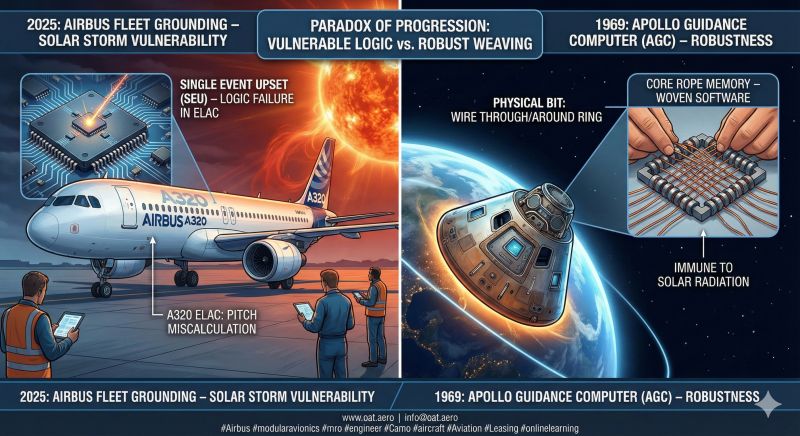
In 2025, a solar storm managed to ground a significant portion of the global Airbus fleet, but in 1969, flying outside the protection of Earths magnetic field, the Apollo Guidance Computer (AGC) didn’t have any issues; so what is vulnerable in Airbus and is it isolated? The Vulnerable Architecture in this case is the ELAC,
Airbus fleet grounding – but Apollo missions didn’t have any problems… Read More »

If you work in aviation—whether you are signing the Certificate of Release to Service, managing the Continuing Airworthiness, or negotiating the lease terms—you likely view a commercial aircraft as a known quantity from your specific standpoint. It is a collection of parts, components, chapters, a sum of flight cycles and flying hours, and a precise
An Invisible Conversation at 35,000 Feet Read More »
The planning and execution for technical flights, such as Maintenance Check Flights (MCF) and often lease acceptance flights, require attention to detail with regulatory compliance, particularly when operating under Part NCC (Non-Commercial Complex) or Part SPO (Specialised Operations) with the UK CAA and EASA. Technical Flight Solutions Ltd (TFS), operating under the supervision of the

A fan blade’s profile is its shape, which is meticulously designed to act as an airfoil, similar to an aircraft wing. It has a rounded leading edge and a tapered trailing edge, with a curved suction side and a flatter pressure side. As the engine’s fan rotates, this profile generates lift, creating a pressure difference
Jet Engine Blade Profile and Function Read More »