
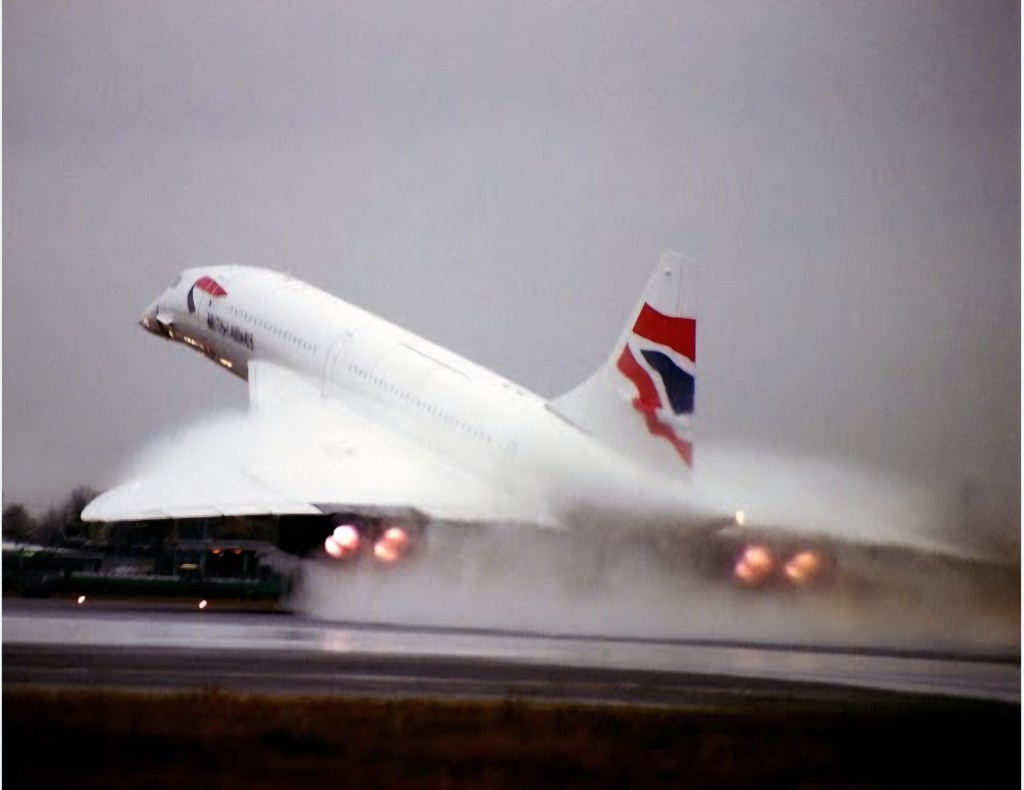
How a Subsonic Jet Engine Core Can Power a Supersonic Aircraft & Why Concorde’s engines did not run supersonically, even though the aircraft did
When people think of supersonic flight, they often imagine air screaming through the engine faster than the speed of sound.
In reality, the opposite is true.
Inside almost every jet engine, including the Olympus 593 that powered Concorde, the airflow through the compressor must remain subsonic.
Supersonic flow inside the compressor would create shock waves, disrupt pressure rise, damage efficiency, and could lead to compressor stall or surge.
So how can an aircraft travel at Mach 2 while the air inside the engine is moving much more slowly?
The answer lies in one of the most remarkable pieces of aerodynamic engineering ever built: the supersonic intake system.
Concorde’s variable-geometry intake used moving ramps and controlled shock waves to decelerate and compress the airflow before it reached the engine core.
The Problem With Supersonic Air
At Mach 2, the incoming air approaches the engine at roughly 600 m/s, depending on altitude and temperature.
A compressor cannot accept that airflow directly.
Axial compressor blades are designed to compress air progressively, and supersonic flow through the compressor would generate shock waves and major efficiency losses.
The engine therefore needs the airflow to arrive at the compressor at a much lower, subsonic speed.
In practical terms, the intake system must slow the air dramatically before it reaches the compressor face.
Concorde’s Intake Was Doing a Huge Share of the Work
On Concorde, the intake system performed this task.
The Olympus 593 engines themselves were relatively conventional reheated turbojets.
The real supersonic magic happened before the air even reached the compressor. Concorde’s intake was a variable-geometry, mixed-compression inlet with moving ramps that generated and controlled oblique shocks, followed by a terminal shock and subsonic diffusion.
As supersonic air entered the intake, the ramps created oblique shock waves that gradually reduced airflow speed while increasing its pressure.
These shocks converted part of the aircraft’s kinetic energy into pressure energy.
By the time the airflow reached the compressor face, it had been slowed from Mach 2 to subsonic speed.
This process was extremely efficient.
Concorde’s intake contributed a very large share of the overall pressure recovery of the propulsion system at cruise, which is why engineers often say a large part of the compression happened before the air even entered the engine.
The Role of the EngineOnce the airflow had been slowed and compressed by the intake, the Olympus 593 performed the familiar tasks of a turbojet.
Air was further compressed by the compressor, mixed with fuel in the combustor, and expanded through the turbine and nozzle system to produce thrust.
Concorde also used reheat during takeoff and during acceleration through the transonic and into the supersonic regime.
Reheat added fuel to the exhaust stream to raise thrust for short periods.
Concorde then cruised at Mach 2 in dry power, with reheat switched off.
At that stage the aircraft was already travelling fast enough that the propulsion system benefited strongly from ram compression.
The intake had slowed and compressed the incoming air so effectively that a significant portion of the pressure rise entering the engine had already been achieved ahead of the compressor.
The engine core therefore did what it was designed to do best: operate with controlled, subsonic airflow through the compressor, maintaining stable pressure rise and efficient combustion.
The Final Step: Accelerating the Exhaust
After combustion and turbine expansion, the hot exhaust gases still contained significant energy.
That energy was converted into jet velocity in the nozzle system.Concorde used a variable exhaust system integrated with reheat and the airframe nozzle arrangement.
The nozzle geometry changed with operating condition to support takeoff thrust, transonic acceleration, cruise efficiency, and reverse thrust after landing.
At cruise, the nozzle system helped optimise expansion and contributed a meaningful share of total propulsion-system thrust.
The result was a very high velocity exhaust jet that helped sustain Mach 2 cruise.
A System That Worked as OneWhat made Concorde’s propulsion system remarkable was that the engine was only one part of the solution.
The intake slowed and compressed the supersonic airflow.The engine core compressed and burned the air efficiently.
The turbine extracted energy to drive the compressor.
The nozzle system accelerated the gases and helped turn pressure and temperature into thrust.
Together these components formed a carefully balanced propulsion system designed specifically for supersonic flight.
The aircraft itself travelled faster than the speed of sound, but the airflow inside the engine core remained controlled and subsonic, which is exactly where a conventional axial-compressor gas turbine works best.
Concorde’s designers understood a crucial principle of high-speed propulsion: supersonic flight is not just about powerful engines, but about managing the airflow before it ever reaches them.
Follow us on LinkedIn and email any enquiries to info@oat.aero and check out the website for courses www.oat.aero