
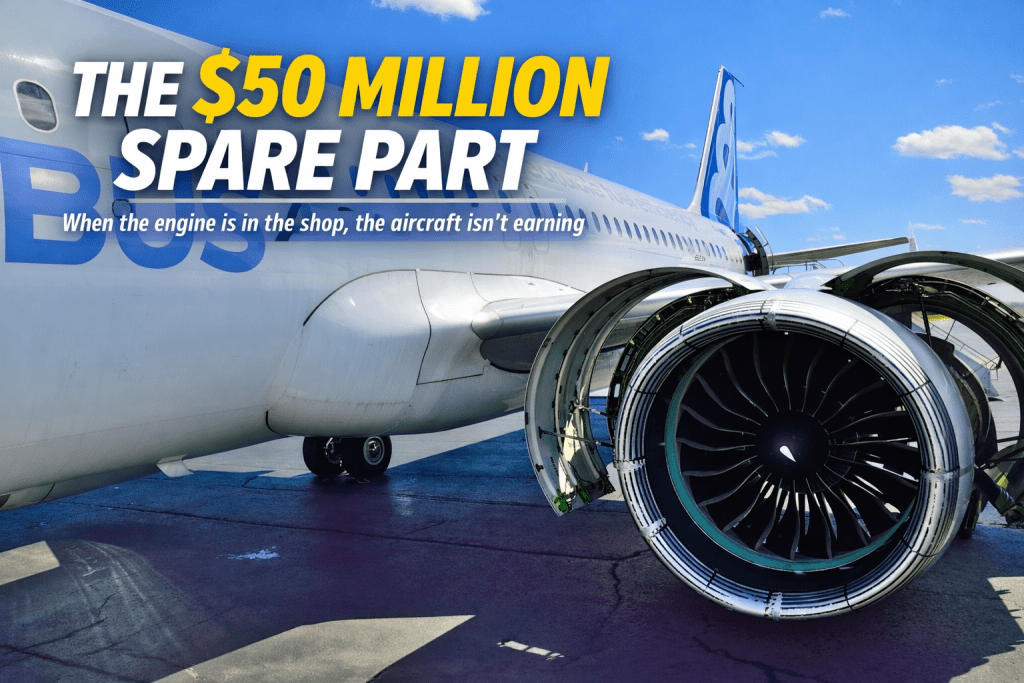
Sometimes the most expensive spare part is not a single component, it is an entire aircraft and that might sound exaggerated — until you look at how modern fleets actually operate.
A modern turbofan engine can represent a very large share of an aircraft’s asset value.
Depending on type, configuration, and maintenance status, a single engine can be worth tens of millions of dollars, and the landing gear could be worth millions of dollars.
For example if an engine is unavailable, the aircraft is unavailable, an engine removal immediately affects capacity, schedules, and revenue.
That is why, quietly, behind the scenes, engines have become the pacing item in modern fleet operations; new engines are not reliable for long wing time in some cases.
The public sees aircraft, operators see engines.
Passengers see a grounded aircraft and assume low demand or airline strategy, but often the real story is simpler; the engine is in the shop.
The spare engine is already covering another aircraft or more commonly there is no spare and so you ground one aircraft to keep another going.
The queue for parts or overhaul slots is long, this is not about poor planning but a global system under strain.
New-generation engines achieved remarkable fuel efficiency gains.
Higher temperatures, tighter tolerances, advanced materials, and complex architectures all delivered lower fuel burn and emissions, but those same advances also increased technical complexity and sensitivity to durability and maintenance cycles.
Global fleets expanded rapidly, MRO capacity did not scale at the same pace, skilled labour shortages emerged post-pandemic and parts supply chains became less predictable with the result is a system where turnaround time matters more than ever.
An engine in a shop is not just a maintenance event, often it is a temporary capacity reduction and when an engine stays off-wing longer than planned, airlines face choices:
• Lease a spare engine at significant cost
• disrupt schedules
• Delay growth plans
• Park otherwise serviceable aircraft
None of these are dramatic decisions, they are rational responses to protect network reliability, but collectively, they reshape fleet economics.
Aircraft utilisation assumptions become less certain, maintenance planning becomes a strategic function and spare engine access becomes a competitive advantage.
Historically, airlines managed fleets around airframes but reliability forces operators plan around propulsion availability and maintenance throughput, often this can affect lease costs and conditions also.
Because the cost of a grounded aircraft is not just technical — it is commercial:
Lost sectors
Crew and slot inefficiencies
Customer confidence impacts
A single engine event can ripple across an entire network for days.
That is why spare engines are no longer viewed as backup hardware, they are operational insurance and this is not a story about one manufacturer, one airline, or one engine type; it is a systems story.
Aviation has always optimized for safety first and efficiency second, now it must also optimize for industrial resilience and the constraint is no longer only engineering.
It is supply chain capacity, overhaul throughput, and realistic maintenance forecasting.
This changes how CAMO teams plan, how lessors assess risk, and how airlines think about growth.
No passenger ever asks what engine is on the wing, but every passenger depends on that engine being available, maintained, and supported by a functioning global ecosystem.
Modern aviation does not just run on fuel, it runs on maintenance capacity, logistics realism, and disciplined planning.
Follow us to learn more on LinkedIn or check out our training courses https://oat.aero/ or email in**@*at.aero for requests, we have many more courses and offer hosting options, LMS solutions and outsourcing options.