
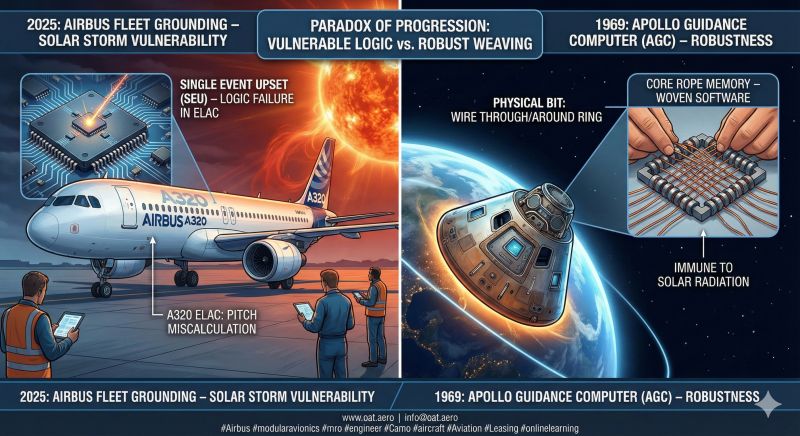
In 2025, a solar storm managed to ground a significant portion of the global Airbus fleet, but in 1969, flying outside the protection of Earths magnetic field, the Apollo Guidance Computer (AGC) didn’t have any issues; so what is vulnerable in Airbus and is it isolated?
The Vulnerable Architecture in this case is the ELAC, SEC, and FAC, but this was not a mechanical failure; it was a logic failure in the ELAC (Elevator Aileron Computer).
The Airbus fly-by-wire architecture is a hierarchy of “Law” for control, the ELAC (Elevator Aileron Computer) that controls pitch (elevators) and roll (ailerons), then we have the SEC (Spoiler Elevator Computer), which controls spoilers for roll/speed brakes and acts as a backup for the elevators.
The FAC (Flight Augmentation Computer) is the final piece and controls the rudder and provides flight envelope protection (like wind sear alerts and Alpha Floor).
The 2025 issue is masked in progression, modern avionics use high-density microprocessors and these chips function using microscopic transistors that are incredibly sensitive.
When a high-energy particle (from a solar flare) strikes a silicon chip, it can deposit enough charge to flip a 0 to a 1 and this is a Single Event Upset (SEU) which is the root of concern.
In the case of the A320, the corrupted the data in the ELAC caused it to miscalculate the aircraft’s pitch.
The computer did exactly what it was programmed to do, but it reacted to bad data and didn’t see any fault.
This is where pilots come in, with faults such as this or GPS issues which can result in heading changes.
So why did Neil Armstrong and Buzz Aldrin not experience “un commanded pitch down” during their solar exposure?
Because their software was woven, not written, the Apollo Guidance Computer used Core Rope Memory; this was not a silicon chip storing electric charges, it was copper wires threaded through magnetic iron rings.
If the wire went through the ring, it was a “1”.
If the wire went around the ring, it was a “0”.
This weaving was done by hand by textile workers in factories (often referred to by engineers as “LOL Memory” or Little Old Lady memory).
To “flip” a bit on an Airbus ELAC, you just need a stray sub-atomic particle to disturb a microscopic electron gate.
To “flip” a bit on Apollo, you would physically have to cut a copper wire and re-route it.
The 2025 grounding is not because our engineering is worse, but because it is smaller and we have traded the physical robustness of iron and copper for the processing speed of silicon.
Computers might not get tired, they might have redundancy, but they still have curveballs.
Follow us on LinkedIn to learn more and why not check out some of the courses we offer at www.oat.aero or email in**@*at.aero for any enquiries.